
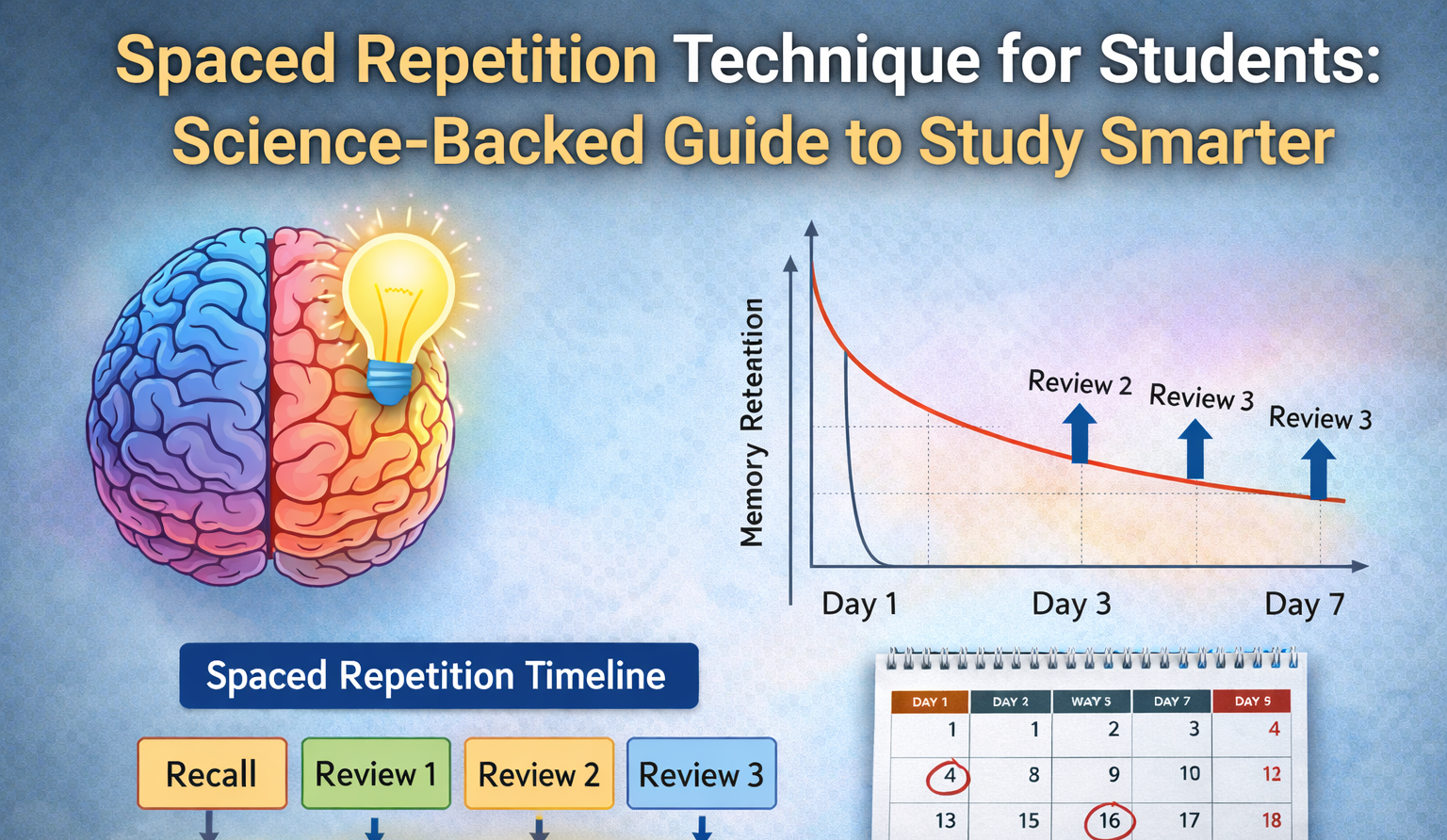
Every student has experienced this. You study a chapter for two hours, feel confident about it, go to sleep, and by the next morning half of it is already gone. A week later, you barely remember it existed. This is not a memory problem. This is just how the human brain works by default.
The brain does not hold on to information it does not use. If you read something once and never return to it, the brain treats it as unimportant and slowly lets it fade. This is called the forgetting curve, and it affects every single person regardless of how intelligent they are.
Spaced repetition is the method that fights this directly. Instead of reading a topic once and hoping it sticks, you revisit it at carefully timed intervals. Each time you review, the memory gets stronger and lasts longer before it starts fading again. Over time, the information moves from short-term memory into long-term memory, where it stays.
This guide explains exactly what spaced repetition is, why science backs it up, and how you as a student in India can start using it from today, whether you are preparing for board exams, JEE, NEET, or any competitive exam.
What Is Spaced Repetition and Where Did It Come From
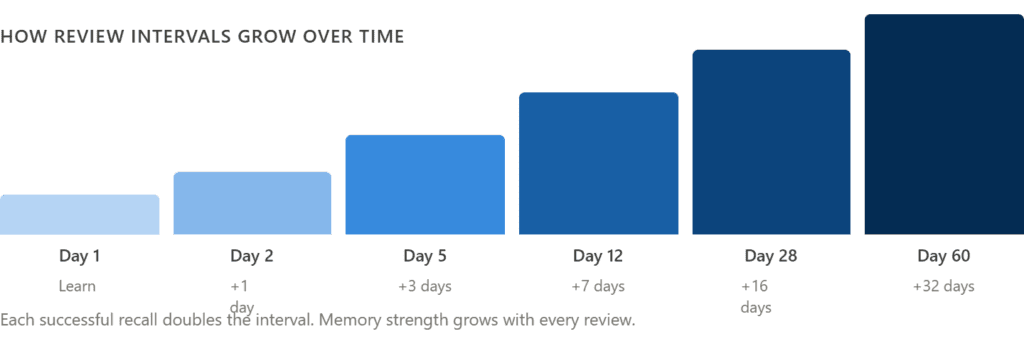
Spaced repetition is a learning technique where you review information at increasing time intervals. You do not study the same thing every day. Instead, you study it, wait a bit, review it again, wait longer, review again, and so on. Each successful recall pushes the next review date further into the future.
The idea is not new. A German psychologist named Hermann Ebbinghaus studied memory in the 1880s and discovered the forgetting curve, which shows how quickly people forget newly learned information when they do not review it. He found that without any revision, people forget about 50 percent of new information within a day and up to 70 percent within a week.
Building on this, a Polish educator named Piotr Wozniak developed the first computerised spaced repetition system in the 1980s. He created an algorithm called SM-2 that calculated the ideal time to review each piece of information based on how well the student remembered it. This algorithm later became the backbone of many modern study apps including Anki, which is widely used by medical students, language learners, and competitive exam aspirants around the world.
The core principle is beautifully simple: review information just before you are about to forget it. That moment of effortful recall, when you are on the edge of forgetting, is exactly when the memory gets strengthened the most. Scientists call this the testing effect or retrieval practice effect, and it is one of the most well-supported findings in learning science.
The Science Behind Why It Works
To understand why spaced repetition works so well, you need to understand a little about how memory actually functions in the brain.
When you learn something new, your brain forms a connection between neurons called a synaptic connection. This connection starts out weak. If you never use it again, it gradually weakens and eventually fades. This is forgetting. But every time you recall that piece of information, the connection gets reinforced and becomes stronger. The more times you recall it, the stronger and more permanent it becomes.
Spaced repetition takes advantage of something researchers call the spacing effect. Studies going back over a century consistently show that distributing practice sessions over time leads to far better long-term retention than massing all study into one session. One widely cited study published in the journal Psychological Science found that students who used spaced practice retained significantly more material over the long term compared to students who used massed practice, even when total study time was the same.
There is also something called desirable difficulty at play here. When you try to recall something that you have not looked at for a few days, the effort your brain puts into retrieving that memory is exactly what cements it. Easy recall does not strengthen memory much. Slightly difficult recall strengthens it a great deal. This is why reviewing something just before you are about to forget it is more powerful than reviewing it while it is still fresh in your mind.
For Indian students preparing for exams with massive syllabuses, this is extremely useful. You do not need more hours. You need smarter timing.
How Spaced Repetition Is Different from Regular Revision
Most students revise by re-reading their notes or textbook chapters a few times before the exam. This feels productive because the information looks familiar as you read it. But familiarity is not the same as memory. Recognising something when you see it is very different from being able to recall it in an exam hall when the book is not in front of you.
This is where spaced repetition takes a completely different approach.
Regular revision is passive. You read through your notes and think yes, I know this. Spaced repetition is active. You look at a question or prompt, try to recall the answer from memory, and then check if you were right. That act of retrieval is what builds lasting memory.
Regular revision usually happens in big blocks close to the exam. You spend three days before the test going over everything you studied in three months. Spaced repetition spreads that reviewing across the entire study period, a little bit every day, so by the time the exam arrives most of the material is already firmly stored in long-term memory.
Regular revision treats all topics equally. You might spend equal time on chapters you know well and chapters you barely remember. Spaced repetition is intelligent. It automatically gives more review time to the things you find difficult and reduces time spent on things you already know well.
For a student preparing for exams like NEET or UPSC where the volume of information is enormous, this efficiency is not just helpful, it is genuinely necessary.
Step-by-Step: How to Start Using Spaced Repetition Today
You do not need any special tools to get started. Here is a simple, practical way to begin using spaced repetition in your current study routine.
Step 1: Study a topic properly the first time. Do not try to use spaced repetition as a shortcut to avoid reading carefully. Go through the chapter, understand the concepts, and take brief notes in your own words.
Step 2: Create small review cards or questions. After studying, write down five to ten questions based on what you just learned. These could be factual questions, concept questions, or application questions. The question goes on one side and the answer on the other.
Step 3: Review the next day. The following day, go through your questions and try to recall each answer without looking. Mark each card as easy, okay, or hard based on how well you remembered.
Step 4: Follow a review schedule based on your rating. If you recalled something easily, your next review is in four to five days. If it was okay, review in two to three days. If it was hard, review again tomorrow.
Step 5: Keep extending the gaps for well-remembered material. Each time you successfully recall something, push the next review date a bit further. Material you know very well might eventually only need a monthly review.
Step 6: Never skip hard cards. The cards that are difficult for you are the most important ones to keep reviewing. Do not avoid them because they are uncomfortable. Those are exactly the gaps your exam will find.
The Best Tools for Spaced Repetition Students Can Use
Once you understand the method, the right tools make it much easier to apply consistently. Here are the most practical ones for Indian students.
Anki is the most powerful free spaced repetition app available. It uses an algorithm to automatically schedule your review sessions based on how well you recalled each card. You can create your own flashcard decks for any subject, add images, formulas, and even audio. Medical students preparing for NEET PG and USMLE swear by it. It is free on desktop and Android, and has a paid iOS version.
Anki shared decks are another big advantage. The Anki community has already created thousands of decks for common subjects including Biology, Chemistry, History, and Geography. You can download these and edit them to match your specific syllabus instead of building everything from scratch.
Notion or physical index cards work well if you prefer something simpler. Write a question on one side and the answer on the other. Keep your cards grouped by subject and follow a manual review schedule using a simple calendar.
Quizlet is a more beginner-friendly alternative to Anki. It has a cleaner interface and also uses spaced repetition in its learning mode. Many Class 11 and Class 12 students use it for subjects like Economics, Political Science, and English Literature.
A simple notebook with a review calendar is the most low-tech option and works perfectly well. Write topics in a notebook, mark the date you studied them, and set review reminders in your phone for day 1, day 3, day 7, day 14, and day 30.
The tool matters less than the habit. Pick whichever one you will actually use every day.
How to Apply Spaced Repetition to Different Subjects
Spaced repetition works for every subject but the way you apply it needs to be slightly different depending on what you are studying.
For Science subjects like Physics, Chemistry, and Biology, the best approach is to make cards for formulas, reactions, definitions, and diagrams. For Biology especially, NEET aspirants create cards for every organ system, disease, enzyme, and process. One card might ask what is the function of the mitochondria and the answer is the site of aerobic respiration and ATP production. Simple, direct, testable.
For Mathematics, spaced repetition works slightly differently because you cannot just memorise a formula. You need to practise applying it. Create cards that give you a problem type and ask you to recall the method or formula needed to solve it. Use spaced repetition for identities, theorems, and standard results that need to be recalled instantly.
For History and Political Science, create cards with dates, events, causes, effects, and key personalities. For UPSC preparation, many aspirants make cards for every article of the Constitution, every amendment, and every landmark judgment.
For languages and English, spaced repetition is outstanding. Create cards for vocabulary words, grammar rules, idioms, and phrases. Language learning through spaced repetition is so effective that entire apps like Duolingo are built around this single principle.
For any exam with MCQs, after solving a past paper, turn every question you got wrong into a spaced repetition card. The mistake becomes the learning material.
Common Mistakes Students Make with Spaced Repetition
Spaced repetition is a powerful technique but only if you use it correctly. Many students try it for a week, do not see instant results, and give up. Here are the mistakes to avoid.
Making cards too long is one of the most common problems. A card that asks you to explain photosynthesis in detail is not a good spaced repetition card. Good cards are short and test one specific thing. Break big topics into many small cards instead of one long one.
Skipping review sessions destroys the system. The whole point of spaced repetition is timing. If your card is scheduled for review on Tuesday and you skip it until Friday, the interval tracking gets disrupted and the method loses its effectiveness. Consistency matters more than intensity here.
Only making cards without actually using them is surprisingly common. Some students spend hours making beautiful Anki decks and then never open the app for daily reviews. The creation of cards is just the first step. Daily review is where the learning happens.
Starting too close to the exam is another mistake. Spaced repetition is a long-term strategy. If your exam is in two weeks and you are starting today, you will not get the full benefit. Ideally, begin three to six months before your exam so the intervals have room to stretch out and consolidate memory properly.
Not adjusting difficulty ratings honestly is also a problem. Some students mark hard cards as easy because they feel good when the next review is far away. Be honest with yourself. If you struggled to recall something, mark it as hard so it comes back soon.
A Simple 4-Week Starter Plan for Indian Students
If you want to start using spaced repetition right now, here is a practical four-week plan to build the habit without feeling overwhelmed.
In week one, pick one subject and one chapter. After reading it, create 15 to 20 flashcards. Review them the next day and mark each as easy, okay, or hard. Spend no more than 20 minutes on reviews each day.
In week two, add a second subject. Continue reviewing your week one cards on their scheduled dates. By now you will notice that easy cards from week one are coming back less frequently, which frees up time for new material.
In week three, add your third subject and begin making cards from past paper questions you got wrong. Your daily review pile will now be a mix of old and new cards, which is exactly how the system is supposed to work.
In week four, your habit should be starting to feel natural. Review cards every morning before new study begins. Keep your daily review session to 20 to 30 minutes. This is a non-negotiable part of your study day, just like brushing your teeth.
By the end of four weeks, you will have a growing deck of tested, organised material that is being actively reinforced in your memory every single day.
Frequently Asked Questions
How much time should I spend on spaced repetition reviews each day?
For most students, 20 to 30 minutes of daily review is enough. The key is doing it every day without skipping. If you fall behind and your review pile builds up, spend one catch-up session clearing the backlog and then return to the daily routine.
Can spaced repetition replace reading the textbook?
No. Spaced repetition is a revision tool, not a first-time learning tool. You still need to read and understand the material properly before making cards. Think of spaced repetition as the system you use to make sure what you learned does not fade before the exam.
Is Anki difficult to use for beginners?
Anki has a small learning curve at the beginning but it becomes very straightforward within a few days of regular use. Many YouTube tutorials are available that explain setup in Hindi and English for Indian students. Alternatively, start with Quizlet which is simpler and still uses spaced repetition principles.
How early should I start spaced repetition before my board exam?
Ideally start at the beginning of your academic year or at least four to six months before the exam. The longer the time frame, the more the intervals can stretch and the stronger the long-term retention becomes. Starting two weeks before the exam will still help but the impact will be much smaller.
Can I use spaced repetition for Maths?
Yes, but use it for formulas, theorems, and standard results rather than full problems. Create cards that give you a problem type and ask you to recall the relevant formula or method. Pair spaced repetition with regular problem-solving practice for best results in Maths.
What if I forget a card completely during review?
That is completely normal and is actually useful information. When you cannot recall something at all, mark it as hard and it will come back very soon. Some Anki users reset a card entirely when they fail to recall it, sending it back to day one intervals. Both approaches work. The important thing is not to feel discouraged. Forgetting something and then relearning it actually creates a stronger memory than if you had never forgotten it.
Does spaced repetition work for UPSC preparation?
It works extremely well for UPSC. The exam covers an enormous range of subjects, including History, Geography, Economy, Polity, Environment, and Current Affairs. Making spaced repetition cards for static GS topics ensures you do not forget material you studied months ago. Many serious UPSC aspirants use Anki as a core part of their preparation.