
Ask any student in India what their biggest problem with studying is and most of them will say the same thing. They sit down to study, open their books, and within twenty minutes their mind is somewhere else entirely. The phone buzzes, a thought pops up, the ceiling becomes very interesting. Before they know it, an hour has passed and almost nothing has been done.
This is not a discipline problem. It is a focus problem. And the Pomodoro Technique is one of the simplest, most practical solutions for it.
The Pomodoro Technique is a time management method where you study in short, focused bursts of 25 minutes followed by a 5 minute break. That is it. No complicated system, no expensive tools, no major changes to your life. Just 25 minutes of complete focus, then a short rest, then repeat.
It sounds almost too simple to work. But students around the world, including thousands in India preparing for boards, JEE, NEET, and UPSC, use this method daily because it genuinely helps them sit down, focus, and get through their syllabus without burning out.
This guide will explain exactly what the Pomodoro Technique is, where it comes from, how to use it step by step, how to adapt it for the Indian student context, and how to make it a daily habit that actually sticks.
What Is the Pomodoro Technique and Where Did It Come From
The Pomodoro Technique was created by an Italian student named Francesco Cirillo in the late 1980s. He was struggling to focus while studying at university and decided to use a kitchen timer to hold himself accountable. The timer he picked up happened to be shaped like a tomato. Pomodoro is the Italian word for tomato, and that is how the technique got its name.
The method Cirillo developed is built around one core observation: the human brain cannot sustain deep focus for hours at a stretch. Trying to study for two or three hours continuously without any break leads to declining concentration, restlessness, and fatigue. Short, intentional work sessions with planned breaks work far better with how the brain naturally operates.
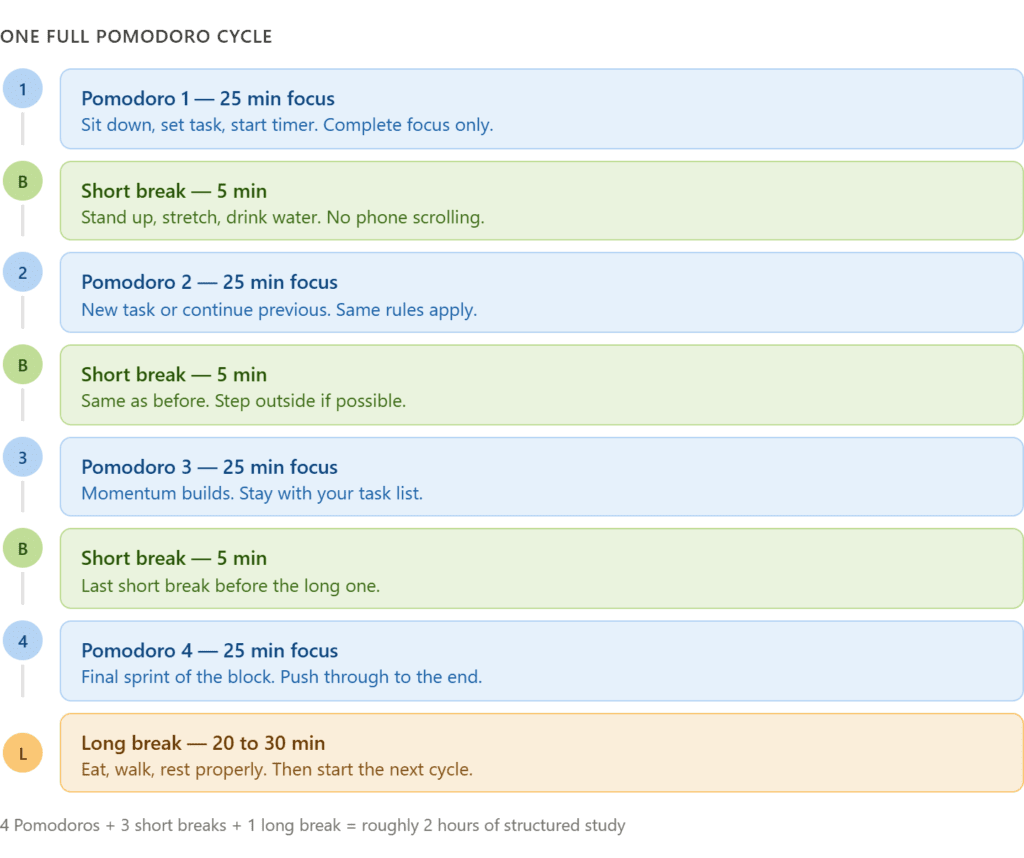
The basic structure is simple. You set a timer for 25 minutes and study with complete focus during that time. When the timer goes off, you take a 5 minute break. After every four such sessions, you take a longer break of 20 to 30 minutes. Each 25 minute session is called one Pomodoro.
The reason this works has to do with something psychologists call attention fatigue. Your ability to focus is not unlimited. It depletes with sustained use, just like a muscle. Short breaks allow that attention resource to partially recover so you can return to studying with renewed concentration. By working in sprints rather than marathons, you actually get more quality study time out of each hour than you would by trying to grind through without stopping.
For Indian students who often feel overwhelmed by the sheer size of their syllabus, the Pomodoro Technique also helps by making large tasks feel less intimidating. Instead of thinking about studying the entire Chemistry unit, you just focus on the next 25 minutes. That shift in thinking alone can reduce procrastination significantly.
How to Use the Pomodoro Technique Step by Step
Using the Pomodoro Technique correctly takes a little setup the first time but becomes completely natural within a few days. Here is how to do it properly from start to finish.
Step 1: Decide what you are going to study before you start the timer. Do not sit down, set the timer, and then figure out what to study. That wastes the first few minutes of every session. Before each Pomodoro, write down the specific task. For example, read and understand pages 42 to 58 of the Physics chapter on laws of motion or solve 10 practice questions from the Algebra exercise. Having a clear, specific task makes it far easier to stay on track.
Step 2: Remove every distraction before the timer starts. Put your phone on silent and keep it face down or in another room. Close any browser tabs that are not related to your study material. Let your family know you are in a study session. Fill up a glass of water so you do not need to get up. Do all of this before you start the timer, not after.
Step 3: Set the timer for 25 minutes and begin. You can use any timer, the clock app on your phone, a physical timer, or a free Pomodoro app. Start studying immediately. Do not adjust your notes, do not re-read yesterday’s work, do not do anything except the specific task you decided in Step 1.
Step 4: If a distraction or thought comes up, write it down and return to studying. During the 25 minutes, a random thought will come up. You might suddenly remember you need to reply to a message or check something online. Do not act on it. Keep a small notepad nearby and write it down quickly, then get back to studying. You can deal with it in the break.
Step 5: When the timer rings, stop immediately and take your 5 minute break. This is important. When the timer goes off, stop studying even if you are in the middle of something and feeling focused. Stand up, stretch, drink water, look out a window, or walk around the room. Do not scroll your phone during the break. The break is for your brain to rest, not for more stimulation.
Step 6: After four Pomodoros, take a longer break of 20 to 30 minutes. This longer break is when you can eat something, take a short walk outside, listen to music, or do anything relaxing. After the long break, you start the cycle again fresh.
How Many Pomodoros Should Indian Students Do Per Day
One of the most common questions students have is how many Pomodoros they should aim for in a day. The honest answer is that it depends on where you are in your exam preparation, how much time you have outside school or coaching, and what your current stamina for focused study actually is.
For a student in Class 10 or 12 attending school during the day and studying in the evenings, a realistic target is 6 to 8 Pomodoros per day. That adds up to roughly 2.5 to 3.5 hours of pure focused study, which is actually very productive when every minute of it is genuine concentration rather than distracted reading.
For a student on study leave before board exams or a full-time competitive exam aspirant, 10 to 12 Pomodoros per day is a healthy and sustainable target. That is around 4 to 5 hours of deep work. Beyond that, the quality of focus tends to drop significantly and it is better to rest and return strong the next day.
For students just starting out with the technique, begin with just 4 Pomodoros on the first day. Get comfortable with the rhythm and the discipline of actually stopping when the break timer starts. Build up gradually over one to two weeks rather than trying to do ten sessions on day one and feeling miserable.
One useful habit is to track your Pomodoros on a simple sheet of paper. Each time you complete one, make a small mark. At the end of the day, count how many you completed and write it down. Seeing that number grow over the week gives you a concrete sense of progress and builds consistency over time.
Best Apps and Tools for the Pomodoro Technique in India
You do not need any special tool to use the Pomodoro Technique. A basic phone timer works perfectly. But if you want something more structured or motivating, here are some good options that Indian students commonly use.
Forest is one of the most popular focus apps among Indian students. When you start a Pomodoro session, you plant a virtual tree. If you leave the app to check social media or use another app, the tree dies. Over time you grow a virtual forest that represents your focus sessions. It is surprisingly effective at making you think twice before picking up your phone during a session. Forest also has a feature where accumulated in-app currency can be used to plant real trees, which many students find motivating.
Focus To-Do is a Pomodoro timer combined with a task manager. You can create a task list at the start of your study day, assign a number of Pomodoros to each task, and track your progress as you go. It works on both Android and iOS and is completely free for basic use.
Pomofocus is a clean, simple browser-based Pomodoro timer that works well for students studying on a laptop or desktop. No download needed. Just open the website, set your task, and start. It automatically tracks how many sessions you have completed and switches between work and break timers.
A physical timer, the old-fashioned kind you wind up, is also a genuinely good option for students who find their phone too distracting even when using a timer app. Keeping your phone in another room entirely and using a simple timer eliminates the temptation completely.
How to Adapt the Pomodoro Technique for Exam Preparation in India
The standard Pomodoro structure works well as a general framework but Indian students preparing for specific exams often need to adjust it to suit the nature of their preparation.
For Class 10 and Class 12 board exam students, the technique works best when each Pomodoro is assigned to a single subject. Switching subjects mid-session breaks momentum. Use the first session of the day for your hardest subject when your mind is sharpest, then rotate through other subjects across the day.
For JEE and NEET aspirants, problem solving requires longer stretches of uninterrupted concentration than simple reading does. Many students in this category extend their sessions to 35 or 45 minutes instead of 25 and keep the break at 5 to 10 minutes. This modified version, sometimes called a 45/10 Pomodoro, suits the deep thinking that Physics problems or organic Chemistry reactions demand.
For UPSC aspirants, the volume of reading is enormous. Use the 25-minute sessions for reading and note-taking and use the short breaks to do a quick 2-minute active recall of what you just read. This combination turns each Pomodoro cycle into a reading-plus-revision unit, which is highly efficient for covering the vast UPSC syllabus.
For students preparing for language exams or subjects like History and Economics, one session could be dedicated entirely to reading, the next to writing short answers from memory, and the next to going through past paper questions. Rotating task types across sessions keeps the brain engaged and covers multiple skills within the same study block.
What to Do During Pomodoro Breaks
Most students use their breaks incorrectly and this reduces the effectiveness of the whole technique. The break is not just a reward. It is an essential part of the method. What you do during it matters.
During the 5-minute short breaks, the best activities are physical ones. Stand up and stretch your arms, neck, and back. Walk to the kitchen and drink a glass of water. Look out a window at something far away to rest your eyes, especially important if you have been reading from a screen. Take five deep, slow breaths. Do a few jumping jacks. These small physical resets help clear the mental fog that builds up during focused work.
What you should not do during a short break is check your phone. Opening Instagram or WhatsApp during a 5-minute break almost guarantees that the break will stretch to 15 or 20 minutes. Social media is specifically designed to capture attention and hold it. A 5-minute break with your phone is rarely actually 5 minutes.
During the longer 20 to 30 minute break after four sessions, give yourself real rest. Eat something if it is a meal time. Go for a short walk outside. Talk to a family member. Listen to music with your eyes closed. Take a brief nap if you feel tired, but keep it to 15 to 20 minutes so it does not disrupt your rhythm.
The break is not laziness. It is recovery. Treating it seriously is just as important as treating the study sessions seriously.
Common Mistakes Students Make with the Pomodoro Technique
The Pomodoro Technique is simple but there are a few ways students use it incorrectly and then wonder why it is not working for them.
The most common mistake is not preparing the task before starting the timer. If you sit down, start the timer, and then spend five minutes deciding what to study, you have wasted 20 percent of the session before it has even properly begun. Always decide your specific task first, then start.
Stopping the timer to check something quickly is another problem. A phone notification comes in, you think you will check it in two seconds, and suddenly the session is broken. A broken Pomodoro does not count. The session should be restarted from zero if you allow a significant interruption. This rule sounds strict but it is what makes the method work. Knowing you will have to restart creates a strong incentive to ignore distractions.
Trying to do too many Pomodoros too quickly is a mistake beginners often make. Jumping from zero structured study to twelve Pomodoros on day one is exhausting and unsustainable. Start with four sessions, build the habit for a week, then gradually increase.
Using the breaks incorrectly, especially by scrolling through social media, has already been mentioned but it deserves repeating because it is so common. The break is mental rest, not a different kind of stimulation.
Finally, some students use the Pomodoro Technique for the first two days and give up because they do not see magical results immediately. The technique builds its value over weeks of consistent use. The habit of structured, timed focus sessions gradually rewires how you relate to studying and makes sitting down to work feel natural rather than daunting.
A Sample Pomodoro Study Day for an Indian Student
Here is how a complete study day using the Pomodoro Technique might look for a Class 12 student preparing for boards and JEE.
In the morning from 6 to 8 AM, complete four Pomodoros covering Mathematics. Each session focuses on a specific problem type from the exercise, with short breaks for stretching and water. A long break follows with breakfast.
From 9 to 11 AM, do four more Pomodoros on Physics. The first two sessions focus on reading and understanding a new chapter. The third session creates notes and questions from memory. The fourth session solves two to three problems from the exercise.
After lunch and proper rest until 1 PM, complete two Pomodoros on Chemistry, focusing on reactions and mechanisms. Take a proper break and spend time outside or relaxing from 2 to 3 PM.
In the evening from 3 to 5 PM, four more Pomodoros cover Biology or a weaker subject. Use the last session of this block specifically for past paper questions.
From 6 to 7 PM, take a complete break with no studying at all.
In the final evening slot from 8 to 9:30 PM, do three light Pomodoros reviewing the day’s work through active recall and flashcards rather than new reading.
That is a total of 17 Pomodoros, which amounts to roughly 7 hours of focused study in a single day, far more than most students achieve from an unstructured 10-hour sitting.
Frequently Asked Questions
Is 25 minutes too short for studying complex topics?
For many students, especially those new to focused study, 25 minutes is actually the right length because it is short enough to feel achievable. If you find that 25 minutes is too short once you get deeply into a problem or a concept, you can extend sessions to 35 or 45 minutes. The key principle is timed, focused work with planned breaks, not the exact number 25.
Can I use the Pomodoro Technique during coaching class hours?
The Pomodoro Technique is designed for self-study sessions, not for classroom time where the teacher controls the pace. Use it for your home study hours before and after coaching. Some students also use it during self-study periods at coaching institutes.
What should I do if someone interrupts me during a Pomodoro?
If the interruption is unavoidable, pause the timer and deal with it. When you come back, restart the full 25 minutes from zero rather than continuing from where you stopped. Knowing you have to restart encourages you to let non-urgent things wait until the break.
How do I handle a subject that needs more than 25 minutes to understand a single concept?
Keep the timer running through difficult concepts. You do not need to finish a concept neatly within one Pomodoro. When the timer ends, take your break and then continue in the next session. The concept gets your full attention across multiple focused sessions which is actually more effective than a single exhausting two-hour stretch.
Does the Pomodoro Technique work during the final week before exams?
It works very well during exam week. Use each Pomodoro for a specific revision task such as going through one chapter’s notes, solving a past paper section, or doing active recall on a topic. The structured rhythm prevents the panic-reading that most students fall into during the last few days before an exam.
Can I do the Pomodoro Technique with a study group?
Yes and it works surprisingly well in groups. Everyone studies silently during the 25-minute session and the short breaks become a time to discuss doubts or share quick points. The shared timer creates a sense of collective accountability that many students find motivating.
What if I finish my task before the 25 minutes are up?
Move on to the next task on your list immediately. Keep studying until the timer rings. Do not end the session early just because one task is done. Always have a prepared list of tasks before you begin, so there is always something to move to.