

Every student in India knows that feeling – exams are around the corner, the syllabus feels massive, and you have no idea where to start. Whether you are preparing for your Class 10 boards, Class 12 exams, JEE, NEET, UPSC, or any college paper, studying effectively is not about sitting for 12 hours straight. It is about studying smart.
Most students study hard but still do not get the results they hope for. The reason is simple – they never had a clear plan or the right approach. This guide will walk you through everything you need, from making a proper schedule to using the best techniques so you actually remember what you read.
Why Most Students Struggle to Study Effectively
Before jumping into tips and tricks, it helps to understand why so many students find it hard to study productively. The truth is, it is rarely about intelligence. It is mostly about habits, environment, and approach.
In India, students often face a heavy syllabus, pressure from family, and competition from lakhs of other students appearing for the same exams. This pressure, rather than pushing them forward, often leads to panic, procrastination, and last-minute cramming. Cramming might help you survive one paper, but it does not build real understanding and the memory fades within days.
Some of the most common struggles students face are studying without any fixed schedule so they keep postponing, getting distracted by phones and social media, reading without understanding by just going through pages, not revising at all so they forget everything before the exam, and studying subjects in a completely random order without any plan.
The good news is that all these problems have simple solutions. Once you build the right routine and use the right methods, studying becomes far less stressful and far more productive.
Step 1: Understand Your Syllabus Before You Begin
The first mistake most students make is picking up a book and starting from page one without knowing what actually matters. Before you study anything, sit down and go through your full syllabus. Download the official syllabus from your exam board’s website and read it carefully.
Once you know the syllabus, divide all the topics into three categories. The first is high-weightage topics that appear in almost every exam. The second is medium-importance topics that come up occasionally. The third is low-priority topics that rarely appear.
This categorisation alone saves a lot of time. Many students waste days on chapters that carry very few marks. Instead, focus your energy on areas that carry more weight in the paper.
Also look at previous years’ question papers. Solve at least five to ten years of past papers to see which topics and question types repeat. Most Indian exams have clear patterns. Once you recognise those patterns, you can prepare in a much more targeted direction.
Understanding your syllabus is not a waste of time. It actually saves you several days of unnecessary reading and helps you move forward with complete clarity about where your effort should go.
Step 2: Make a Realistic Study Schedule
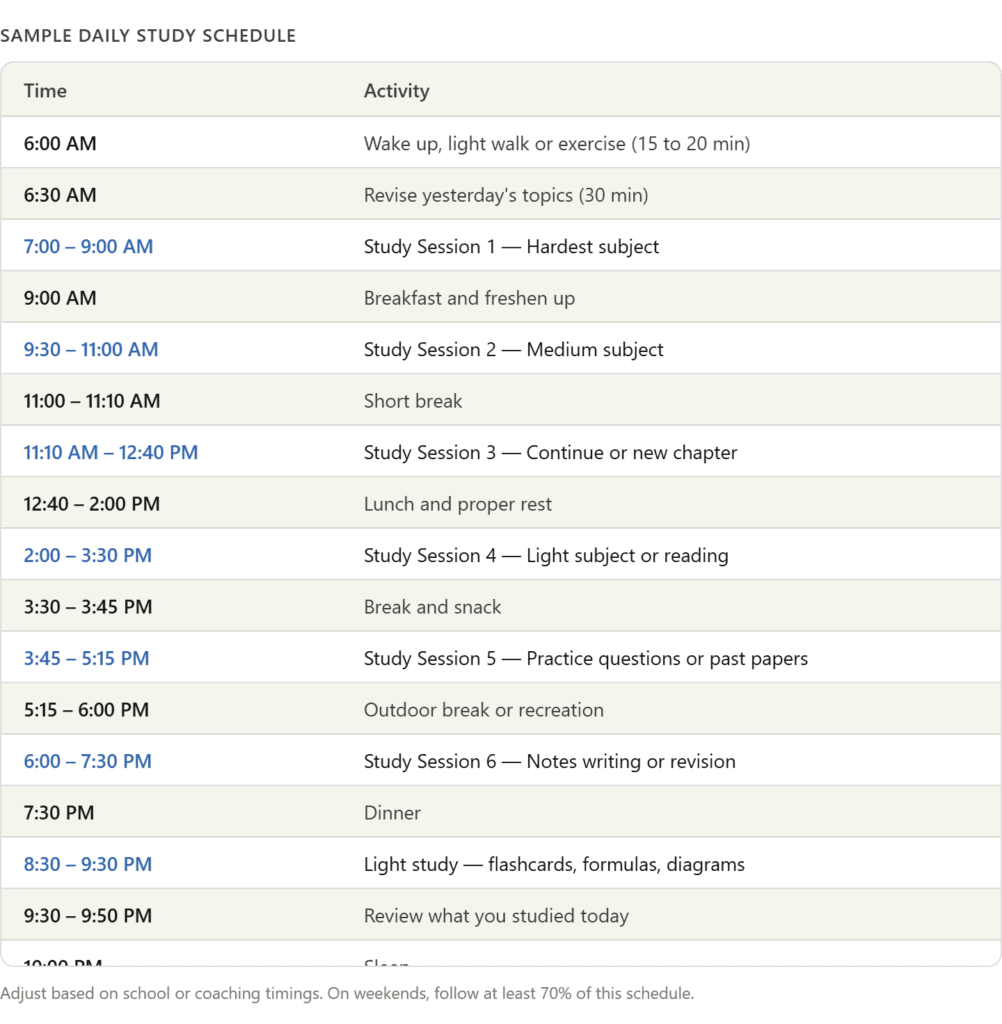
A study schedule is not just a timetable that looks good on paper. It has to be something you can actually follow. Many students make a 16-hour study plan on day one and burn out by day three. The goal is consistency, not intense bursts followed by complete breaks.
Here is how to build a schedule that actually works.
Start by calculating the time you have. Count the number of days until your exam. Subtract time for sleep, eating, bathing, and travel. What remains is your study time. Be realistic. If you have school or coaching during the day, your evening hours become your primary window.
Assign subjects to specific days and time slots. Do not study the same subject all day. Mix things up. Study your hardest subject when your mind is fresh, usually in the morning or early evening. Keep lighter reading for later hours when energy naturally dips.
Step 3: Choose the Right Study Techniques
Reading a textbook repeatedly is one of the least effective ways to study. Your brain needs variety and active engagement to actually retain information. Here are the methods that work best for Indian students preparing for board and competitive exams.
The Pomodoro Technique means studying for 25 minutes and then taking a 5-minute break. After four such sessions, take a longer break of 20 to 30 minutes. This keeps your focus sharp and prevents mental fatigue. It also makes a large syllabus feel manageable when broken into small chunks.
Active Recall means after reading a topic, you close the book and try to recall everything you just read. Write it down from memory. This forces your brain to work and strengthens memory far better than simply re-reading the same text over and over.
Spaced Repetition means revising a topic after one day, then after three days, then after a week, then after two weeks. This spacing moves information from short-term to long-term memory. A free app called Anki can help you automate this process.
The Feynman Technique asks you to pick a concept and explain it in simple language as if teaching it to a 10-year-old. Wherever you get stuck or start using complicated language, go back and study that part again. If you can explain it simply, you truly understand it.
Mind Maps work especially well for subjects like Biology, History, and Economics. Draw the main topic in the centre and branch out to related ideas. This helps you see how concepts connect and works particularly well for visual learners.
Step 4: Build a Distraction-Free Study Environment
Your environment has a huge impact on how well you study. A noisy, cluttered space makes it hard for your brain to concentrate, even with the best intentions.
Keep your study desk clean before you sit down. Put your phone in another room or use apps like Forest or Digital Wellbeing to block distracting apps during study time. Let your family know your study hours so they avoid interrupting. Use a table and chair instead of studying on your bed, because lying down naturally makes you sleepy. Keep water, a snack, and all your books nearby so you do not have to get up frequently.
If your home is too noisy, study at your school or college library during free periods. Some students also find that soft background music or white noise helps them concentrate. Try different settings and find what genuinely works for you.
The goal is to build a space where your brain automatically shifts into study mode the moment you sit down. Over time, this becomes a habit and concentration improves on its own.
Step 5: Take Notes the Right Way
Good notes are one of the most valuable things you can have during exam preparation. But there is a big difference between copying everything from a textbook and taking notes that actually help you study faster.
Write in your own words, not copied sentences from the book. Use headings, short points, and leave white space so the page looks clean and easy to scan. Highlight or underline only the most important lines, not entire paragraphs. Add small diagrams or flowcharts wherever possible, especially for Science and Geography topics.
One very effective method is the Cornell Note-Taking System. Divide your page into two columns. On the left, write key terms or questions. On the right, write your detailed notes. At the bottom, write a summary of the page in three to four lines. This format makes revision much faster because you can cover the right column and test yourself using just the questions on the left.
Your notes become your personal revision guide. The cleaner and more organised they are, the easier your last-week revision will be before the exam.
Step 6: Practice with Mock Tests and Past Papers
Studying theory is only half the job. The other half is practice. Solving previous years’ papers and mock tests is one of the most powerful things you can do in the weeks before an exam. Every serious topper across JEE, NEET, and UPSC credits extensive practice as a major reason for their success.
Solve past papers under real exam conditions. Set a timer, sit in a quiet place, and do not open your notes. After finishing, check your answers carefully. Do not just see what went wrong. Understand why it went wrong.
Keep a mistake journal. Write down every error you make along with the correct answer and the reason behind it. Review this journal before the exam. It will show you exactly where your weak spots are.
Give at least one full mock test per week in the last two months before your exam. For competitive exams like JEE, NEET, CAT, or CLAT, test series from platforms like PW, Testbook, Unacademy, or Allen are very useful for building both speed and accuracy.
Step 7: Revise Smartly and at Regular Intervals
Revision is where most students go wrong. They study everything once and then try to revise the entire syllabus in the last two days before the exam. That is not revision. That is panic reading.
Real revision means going over material at regular intervals throughout your preparation, not just at the end. Every evening, spend 20 to 30 minutes reviewing what you studied that day. Every Sunday, do a quick revision of the entire week. Once a month, go over all the chapters covered so far.
Short revision notes, flashcards, and formula sheets are your best friends here. You do not need to re-read the entire chapter every time. Just go through your notes and test yourself on the key concepts.
The 80/20 rule applies strongly to exam preparation. In most Indian board and competitive exams, roughly 80 percent of the marks come from about 20 percent of the syllabus. Focus your revision on that core 20 percent and your scores will improve significantly.
Step 8: Take Care of Your Health During Exam Season
This is probably the most ignored advice, but it matters more than almost anything else. Your brain is an organ. It needs sleep, food, and oxygen to work well. Sacrificing sleep to study more actually reduces your ability to retain what you read.
Sleep at least 7 to 8 hours every night. Memory consolidation happens during sleep. When you sleep after studying, the brain organises and stores what you learned. Students who pull all-nighters consistently perform worse than those who sleep well.
Eat on time and do not skip meals, especially breakfast. Avoid heavy or oily food during exam season as it makes you feel sluggish and unfocused. Drink enough water throughout the day because even mild dehydration affects concentration.
Take a 20 to 30 minute walk or light exercise every day. Physical activity increases blood flow to the brain and genuinely improves focus. Also manage your stress by talking to parents or friends when you feel overwhelmed. Short breaks watching something funny or listening to music for 15 minutes can help reset your mind.
A student who sleeps well, eats right, and stays calm will almost always outperform a student who stays up all night cramming but arrives at the exam hall exhausted and anxious.
Step 9: Use the Final Week Before the Exam Wisely
The last week before your exam is not the time to start new topics. It is the time to consolidate everything you have already studied and enter the exam hall feeling confident.
On days 7 to 5, go through your short notes and flashcards for all subjects and do a chapter-wise quick revision. On days 4 to 3, solve two to three full past papers under timed conditions and carefully review every mistake. On day 2, do light revision only. Go over your formula sheets, key dates, important diagrams, and the most commonly asked questions. No heavy reading at this stage. On the night before the exam, do not study beyond 9 PM. Lay out your admit card, pens, and everything else you need. Sleep on time.
On the day of the exam, eat a good breakfast, reach the centre early, and stay calm. Trust the preparation you have put in. Panicking in the last few hours never helps anyone.
Frequently Asked Questions
How many hours should I study per day for board exams?
For Class 10 and Class 12 board exams, 6 to 8 hours of focused study per day is enough for most students. Quality matters more than quantity. Six hours of distraction-free study is far more effective than sitting at your desk for 12 hours with your phone nearby.
Is it better to study in the morning or at night?
Most students find morning study more effective because the mind is fresh after sleep. However, this depends on your natural rhythm. Some people focus better late at night. Identify when your concentration peaks and use that time for your hardest subjects.
How can I stop forgetting what I study?
The most common reason for forgetting is not revising at regular intervals. Use spaced repetition by revising after one day, then three days, then a week. Also use active recall by closing your book and testing yourself rather than simply re-reading.
Can I prepare for competitive exams without coaching?
Yes, absolutely. Millions of students crack JEE, NEET, and UPSC through self-study using NCERT books, good reference books, and online resources. What matters is your consistency and method. Platforms like Khan Academy, PW, and Unacademy have excellent free content to get you started.
What should I do if I feel completely demotivated?
Do not wait for motivation to arrive before you begin. Start with just 10 minutes and your brain will usually get into the flow on its own. Break your goals into small daily targets. Seeing small wins every day builds confidence and keeps you moving forward.
How do I manage time for multiple subjects?
Divide your weekly schedule so every subject gets attention at least four to five times per week. Do not leave any subject untouched for more than two days in a row. Rotate subjects within the same day to keep things fresh.
Is it okay to use my phone while studying?
It is best to keep your phone away during study sessions. Even having it on the table nearby reduces focus. Use app-blocking tools during study hours. If you need your phone for study apps, put it in Do Not Disturb mode.