

Most students study the same way. They open their textbook, read through the chapter, maybe highlight a few lines, read it again, and feel like they have done their job. It feels productive. The information looks familiar. But when the exam comes, a lot of it simply is not there.
This happens because reading something repeatedly is not the same as actually learning it. Your brain is not a camera. It does not store everything it sees. It stores what it is forced to work for.
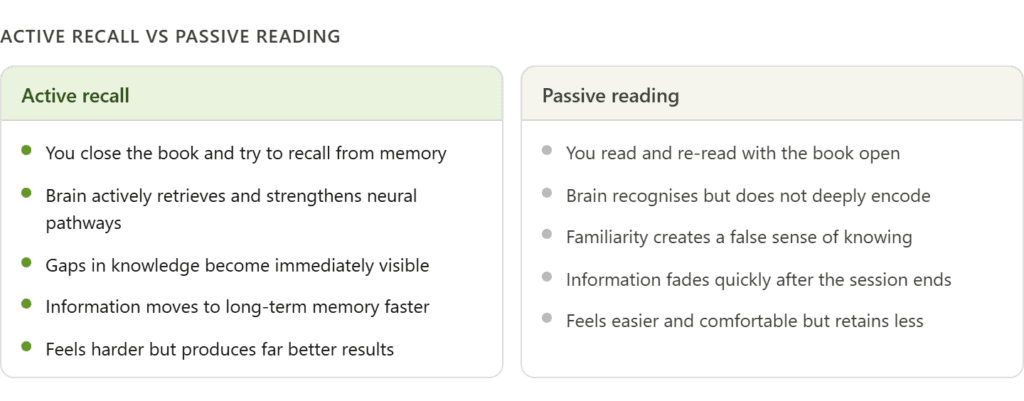
Active recall is the method that changes this completely. Instead of reading and re-reading, you close the book and force yourself to remember what you just studied. You pull the information out of your memory rather than letting it sit passively on the page in front of you. That act of retrieval, however uncomfortable it feels, is exactly what makes memory stick.
This guide explains what active recall is, how it is different from the way most students study, what science says about it, and how you can start using it today for any subject, whether you are preparing for Class 10 boards, JEE, NEET, or UPSC.
What Is the Active Recall Method
Active recall is a study technique where you test yourself on the material you have studied instead of simply reading it again. The idea is to retrieve information from your memory rather than recognise it from a page.
When you read a chapter and then immediately try to write down everything you remember without looking at the book, that is active recall. When a teacher asks a question in class and you think hard before answering, that is active recall. When you cover your notes and quiz yourself using only the headings, that is also active recall.
The method is built on one core insight from memory research: the act of retrieving information strengthens the memory of that information far more than simply seeing it again. Scientists call this the testing effect or the retrieval practice effect. It has been studied in labs and classrooms for over a hundred years and the finding is consistent across ages, subjects, and types of learners.
The term might sound technical but the practice is not complicated at all. In fact, the students who naturally do well in exams often use some version of this without even realising it. They read a topic, close the book, and ask themselves what did I just learn. That simple habit, done consistently, is what separates students who retain information from students who forget it overnight.
For Indian students dealing with heavy syllabuses and high-pressure exams, active recall is not just a useful trick. It is a fundamental shift in how studying works.
Active Recall vs Passive Reading: The Key Difference
To understand why active recall works, it helps to first understand what passive reading is and why it fails so many students.
Passive reading is the most common form of studying. You sit with your book or notes and read through the material from start to finish. Sometimes you highlight sentences. Sometimes you re-read a paragraph that did not make sense the first time. You might copy notes from the board into your notebook. All of this feels like studying because you are engaging with the material. But your brain is mostly on autopilot.
When you read passively, the information enters your working memory briefly and then fades. Because it is right there on the page, your brain has no reason to work hard to hold onto it. The moment you close the book, much of it starts to disappear. This is why students who spend three hours reading a chapter can still fail to recall the main points ten minutes later.
Active recall takes the opposite approach. You put away the book and force your brain to retrieve the information from memory. There is no safety net. Your brain has to actually work. That struggle, that effortful retrieval, is what creates a stronger and longer-lasting memory trace in the brain.
Think of it this way. Passive reading is like watching someone else do push-ups. You see exactly how it is done, it looks easy enough, and you feel like you understand it. But your muscles have not done any work. Active recall makes your brain do the actual exercise. That is the difference.
Research published in the journal Science by Roediger and Karpicke in 2006 showed that students who used retrieval practice remembered significantly more material a week later compared to students who spent the same time re-reading. The re-reading group felt more confident going in but performed worse when it actually counted.
What the Science Says About Active Recall
Active recall is not a study hack invented on social media. It is one of the most well-researched learning strategies in cognitive psychology, with evidence stretching back over a century.
In 1909, a researcher named Arthur Gates conducted one of the earliest studies showing that students who spent a portion of their study time testing themselves performed significantly better on later recall tests than students who spent all their time reading. This finding has since been replicated hundreds of times across different subjects, age groups, and cultures.
The mechanism behind active recall connects to how the brain forms and strengthens memories. Every time you recall a piece of information, the neural pathway associated with that memory gets reinforced. It is like walking the same path through a forest repeatedly. The more you walk it, the clearer and easier to follow it becomes. Reading activates that pathway briefly but retrieval actually strengthens it.
There is also something called elaborative interrogation, which is a form of active recall where you ask yourself why and how questions about what you are studying rather than just what. Studies show that students who interrogate information this way build richer, more connected memories that are easier to recall under exam conditions.
Another relevant finding is about the generation effect. Research shows that when you generate an answer from your own memory, even if you get it partially wrong, you remember the correct answer better after checking than if you had simply read the answer passively. The act of attempting retrieval, even an imperfect one, primes the brain to absorb the correct information more deeply.
For Indian students preparing for exams like NEET and JEE where conceptual understanding matters just as much as factual recall, this is especially relevant. Active recall builds the kind of deep, flexible memory that lets you apply knowledge to questions you have never seen before.
How to Use Active Recall: Step-by-Step
Using active recall does not require any special tools or a complete overhaul of your study routine. Here is a simple, practical way to start from your very next study session.
Step 1: Read and understand the topic first. Do not skip the initial reading. Go through the chapter or section properly and make sure you understand the concepts. Active recall is a retrieval tool, not a shortcut around learning.
Step 2: Close the book and write what you remember. After reading a section, put the book face down and write down everything you can recall on a blank page. Do not worry about order or completeness. Just pull out whatever your memory gives you. This first attempt is the most important step.
Step 3: Check what you missed. Open the book and compare what you wrote against the original material. Note the gaps and the things you got wrong. These gaps are your real study targets, not the things you already remembered.
Step 4: Focus your next reading on the gaps only. Go back and re-read only the parts you forgot or got wrong. Then close the book and test yourself again on those specific points.
Step 5: Use questions instead of notes for revision. Instead of writing out summary notes, turn your notes into questions. For every key point, write a question that would lead to that answer. These questions become your revision tool in the days before the exam.
Step 6: Space your retrieval sessions. Do not test yourself only once. Come back to the same material the next day, then three days later, then a week later. Each retrieval session deepens the memory further. This combination of active recall with spaced repetition is the most powerful study strategy available.
Active Recall Techniques You Can Use Right Now
There is more than one way to practise active recall. Different techniques work better for different subjects and different types of learners. Here are the most effective ones.
The blank page method is the most straightforward. After studying a topic, take a completely blank sheet of paper and write down everything you can remember about it. No peeking. No hints. Just whatever your brain produces. Then open your notes and check. The gaps you find are exactly what you need to study next.
Flashcards are one of the oldest and most reliable active recall tools. Write a question or a key term on one side and the answer on the other. Go through the cards and try to answer before flipping. This works especially well for Biology definitions, Chemistry reactions, History dates, and vocabulary in any language.
The Feynman Technique asks you to explain a concept out loud or on paper in the simplest possible language, as if you are teaching it to someone who knows nothing about the subject. Wherever your explanation breaks down or gets vague, that is the part you do not truly understand yet. Go back, study that section, and try again.
Practice questions and past papers are a form of active recall at a larger scale. Instead of re-reading chapters before an exam, sit down with a blank sheet and answer questions from memory. This is exactly what the exam will ask of you, so it is the most direct preparation possible.
Teaching someone else, even an imaginary student, forces you to recall and organise information in a way that passive reading never does. Many toppers from competitive exams talk about how explaining concepts to their friends helped them understand and remember material far better than any amount of re-reading.
How to Apply Active Recall Subject by Subject
Active recall works across every subject but the way you use it needs to suit the nature of the content you are studying.
For Physics and Chemistry, create cards for formulas, laws, and standard derivations. After reading a derivation, close your book and try to reproduce it step by step on a blank page. For numerical problems, read a solved example once, cover the solution, and try to solve it yourself from scratch. Every mistake shows you exactly where your understanding has a hole.
For Biology, the subject that forms the backbone of NEET preparation, active recall is outstanding. After studying a system or a process, draw it from memory. Label the parts without looking. Write the function of each component in your own words. If you cannot draw the nephron or the human digestive tract from memory, you have not truly learned it yet.
For History and Political Science, convert your notes into questions. For every event, ask yourself what caused it, what happened, and what were the consequences. For every Constitutional article, cover the description and try to recall it from the article number alone. For UPSC aspirants, this method works well for both GS and optional subjects.
For Mathematics, use active recall for theorems, identities, and standard problem types. After practising a type of problem, wait a day and try it again without referring to any worked examples. If you can solve it cleanly from a cold start, the method is in your memory. If you cannot, it needs more work.
For English and language subjects, use flashcards for vocabulary, idioms, and grammar rules. Write a sentence with a blank and try to fill it in. Read a passage and then summarise it from memory in your own words without looking back.
The Biggest Mistakes Students Make with Active Recall
Active recall is simple in concept but students often make a few common errors that limit its effectiveness.
The most frequent mistake is giving up too quickly when recall feels hard. When you close the book and your mind goes blank, it is very tempting to open the book again immediately. Resist that urge. Sit with the discomfort for a minute or two. That struggle is not a sign that the method is not working. It is a sign that it is working exactly as it should. The effort of retrieval is the learning.
Another mistake is using active recall only for the things you already know. Students often test themselves on comfortable, familiar material and avoid the topics they find difficult. This is completely backwards. Active recall is most valuable precisely for the material you keep forgetting. Difficult cards, hard topics, and weak chapters deserve the most retrieval practice.
Skipping the checking step is also a problem. Active recall is not just about pulling information out. It is also about identifying what was wrong or missing and correcting it. If you test yourself and never check your answers carefully, you might reinforce incorrect memories. Always compare your recall against the correct material.
Treating active recall as a one-time event rather than a repeating habit limits its power greatly. A single session of self-testing will help a little. But active recall done consistently over weeks and months, especially combined with spaced repetition, is what creates genuinely durable memory that survives an exam.
Finally, some students make their flashcards or questions too vague or too broad. A card that asks tell me about photosynthesis is not useful. A card that asks what is the role of the stroma in the chloroplast in the Calvin cycle is specific, testable, and far more effective.
Building an Active Recall Habit: A Weekly Plan
Knowing the method is one thing. Building it into your daily routine is another. Here is a simple weekly structure to help you make active recall a consistent habit.
Every day, before you begin new study, spend the first 15 minutes doing active recall on what you studied the previous day. This could mean going through flashcards, answering questions from your notes, or doing a quick blank page recall. This morning retrieval session is the single most important habit change you can make.
After every study session, whether it is one hour or three hours, take ten minutes at the end to close all your material and write down the key points you remember from what you just covered. Do not skip this step even when you are tired. That end-of-session recall is when the memory is freshest and the contrast between what you remember and what you missed is most informative.
Once a week, on a Sunday or your day off, do a broader recall session covering everything you studied during the week. Do not re-read your notes first. Just sit with a blank page and see how much you can recall from the week across all subjects. Then check and fill the gaps.
In the final two weeks before an exam, replace most of your passive revision with active recall practice using questions and past papers. You should be spending most of your revision time answering questions rather than re-reading content.
Frequently Asked Questions
Is active recall better than making notes?
Active recall and note-making are not opposites. Good notes support active recall. The issue is when students make notes and then only ever re-read them passively. Turn your notes into questions and use those questions for retrieval practice. That combination is far more effective than either approach alone.
How long should a single active recall session be?
Most students find that 20 to 40 minute active recall sessions work best before taking a short break. The quality of your retrieval matters more than the length of the session. A focused 25-minute session where you genuinely test yourself will produce better results than an hour of passive re-reading.
Can active recall work for understanding or only for facts?
Active recall works for conceptual understanding too, not just factual memorisation. Use techniques like the Feynman method to test whether you can explain a concept clearly in simple terms. If you can explain it without your notes, you understand it. If your explanation gets vague or confused, you need to go back and study that part more carefully.
What if I cannot remember anything when I close the book?
This is very normal at the start, especially with difficult material. When you cannot recall much, it simply means the material is not yet in memory and needs more study. Read the section again, then immediately try to recall again. With each cycle the amount you can remember will grow. Do not take the initial blankness as failure.
Does active recall work for competitive exams like JEE and NEET?
It works extremely well. In fact, many of the students who crack these exams naturally use active recall without calling it by that name. They solve problems without looking at solutions first. They reproduce reactions from memory. They draw biological diagrams without referring to diagrams in the book. All of that is active recall.
How is active recall different from just doing practice questions?
Practice questions are one form of active recall. But active recall is broader. It includes any method where you retrieve information from memory, whether that is answering questions, doing blank page recall, using flashcards, or teaching a concept to someone else. Practice questions are excellent and should absolutely be part of your preparation, but they are just one tool within the larger active recall approach.
Should I use active recall from the very first day of studying a topic?
You should read and understand the material first. Active recall on content you have not encountered at all is not very useful. But once you have gone through a topic even once, start testing yourself immediately rather than waiting until closer to the exam. The earlier you begin retrieval practice on a topic, the more retrieval cycles you can fit in before the exam.